
Rating: R | Runtime: 120 minutes
Release Date: March 19th, 2010 (Italy)
Studio: Mikado Film / Magnolia Pictures
Director(s): Luca Guadagnino
Writer(s): Barbara Alberti, Ivan Cotroneo, Walter Fasano & Luca Guadagnino / Luca Guadagnino (story)
‘Happy’ is a word that makes one sad.
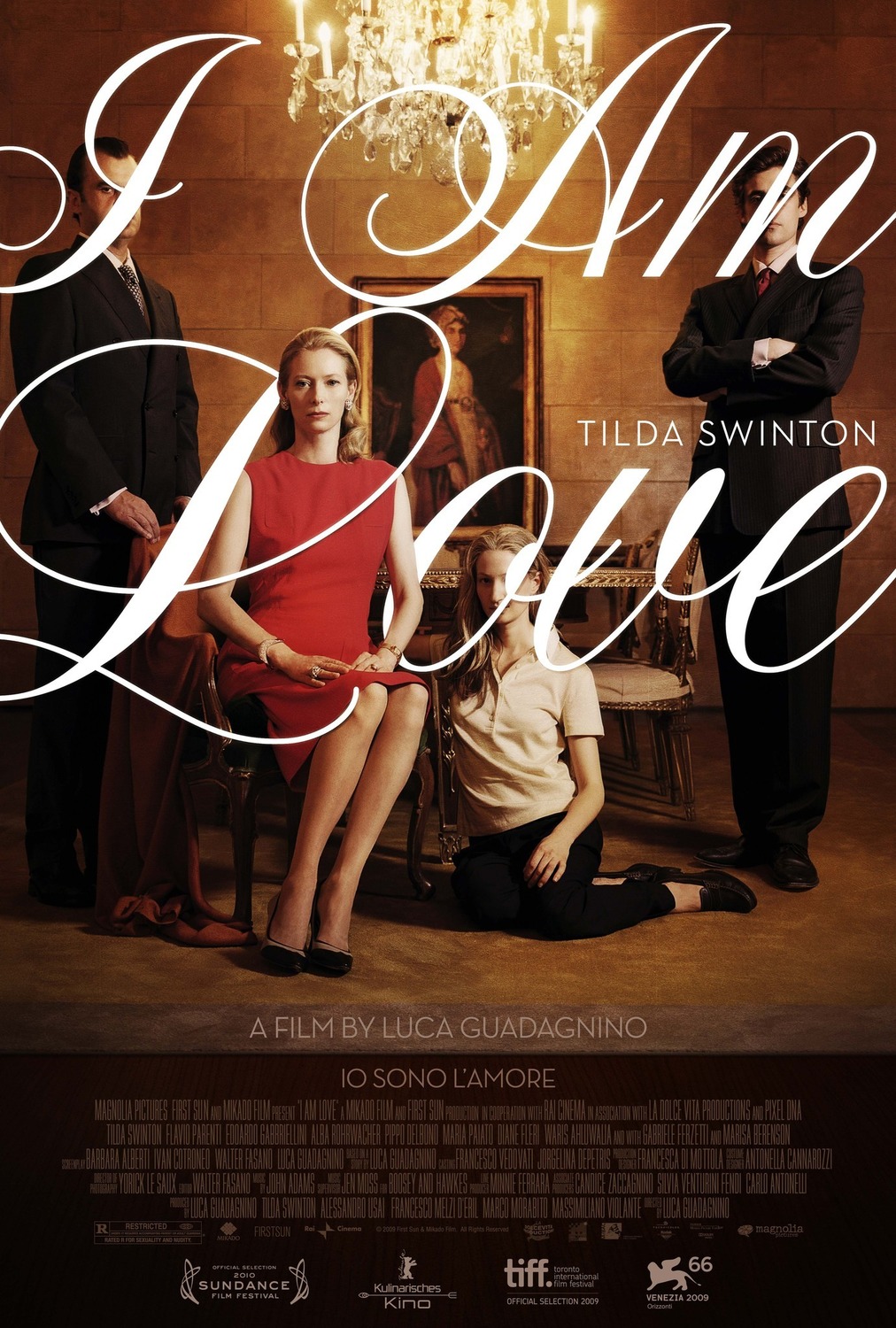
It only took one look at the American poster for Io sono l’amore [I Am Love] to know I needed to see this film. The use of typography over an elegant family portrait that blocks every face but star Tilda Swinton is gorgeous and much more relevant to the work it represents than I’d ever imagine. Characters are often seen with obstructions between them and the camera throughout the entire piece, giving the audience a voyeuristic view into their Italian family’s world. There’s the common display of double doors—one open, the other closed—centered onscreen, portraying the very guarded nature of the Recchis who are always hiding something from others. Secrets are permeating each and every bond between them. And these private maneuvers are always uncovered by either an accepting soul or an unforgiving one to add drama to this overly ambitious story chock-full of deception and life.
When the film was introduced at the 360|365 George Eastman House Film Festival, we were given a tidbit of information told to the presenter secondhand from a talk with director Luca Guadagnino at Sundance. He said the movie formed from his and Swinton’s desire to tackle a melodrama together by exploring the traits inherent in the genre and exploiting them to tell this tale of a wealthy family on the cusp of a new economic world facing them. Their money was accumulated through an industrial factory, the reins of which are passed on during the opening act’s birthday party—a giant family get-together for the elder grandfather, a man with old-fashioned ideals who tells his granddaughter through a face of unmasked disappointment that she still owed him a drawing to replace a ‘novelty’ photo given as a gift in hopes his hard work would carry on through the generations to come. But the father/son duo it falls too argue about what direction to go. The youngest wishes to honor his grandfather’s wishes while the elder looks to sell for the future by retaining the name and identity while passing on the big decisions to another company.
This event serves as the catalyst for everything that follows. Tancredi (Pippo Delbono) is off on business now that he is in control of the company, leaving his wife Emma (Swinton) alone at home to busy herself in trifling affairs with outings with her mother-in-law seem to be the only source of entertainment during her day. Their son Edoardo (Flavio Parenti), angered at what his father is doing to their family legacy, begins putting his efforts towards building a family with new wife Eva (Diane Fleri) and partnering with his chef friend Antonio (Edoardo Gabbriellini) to open a restaurant of delicious, experimental food. And their daughter Betta (Alba Rohrwacher) starts to distance herself from the entire family—finding herself and her sexuality at college, afraid to confide in anyone because she doesn’t know how they’d react. Each evolves off-screen as chunks of time pass with the display of title cards to gloss over weddings and graduations while sticking to the meatier, emotional turmoil of moving towards a future full of disappointment, loneliness, and complete isolation—physically and psychologically.
At the center lies Tilda Swinton’s mysterious puzzle of a woman. She, as the title says, is Love. Constantly living for the lives of those around her, she transplanted herself to Italy—forsaking her Russian heritage by not only changing her name to Emma, but also forgetting what it even was. This bourgeois lifestyle appeals to her sensibilities and yet bores her at the same time to leave parties early to go upstairs and look through magazines or just turn in for the evening alone while Tancredi is off somewhere for work. Giving him her entire being and changing her own essence to make him happy, Emma has lost her way and her opinion to sleepwalk through her existence day after day.
When her precious Edo has a problem or news, she stops what she’s doing to go to him. When Betta can’t hold her secret inside any longer, Emma listens intently and accepts the truth (something she had discovered earlier by accident anyway). And when the duty of attending lunch with her mother-in-law and daughter-in-law arises, she puts on the fancy clothes and façade of happiness to keep up the act. She’s the manifestation of Love for the rest, undeserving of finding her own source until Antonio’s sexuality, something we see her interested in early on, becomes too much to ignore.
I Am Love harkens back to the old days of cinematic melodrama, traveling far into emotionally wrought territory. Populated by close-ups showing each actor in differing states of exaggerated expression, the film grabs hold and renders us helpless against the flowing stream of the family’s progression forward. We become swept up into the grandeur of locales, exquisite performances, and riveting declarations of love publicly and privately, uncaring of the kind of consequences their actions may hold. It becomes a very professionally made daytime soap, offering the same type of heightened reality, but with the care and skill of trained performers and crew.
Every decision is made into a life or death situation put against a beautiful backdrop of European settings with sprawling country greenery, bustling city streets, and exotic architectural wonders (the building Swinton climbs up to look at the CD discovered in her son’s dry cleaning is breathtaking). Add to the cinematography a score so in tune with the visuals that you know it was filmed to the rhythm of its notes—music by John Adams, used at first without permission in hopes that once he’d see a cut he’d allow them to keep it as the underlying signature pulse—and the endeavor is a powerful piece of art worthy of exhibition.
And when it all appears to go too far into that melodrama—even though that’s what it seeks to do—the excitement finds its way to a well-placed valley, allowing the audience to catch its breath and endure the next sharp climb upwards. So many details are included to retain our attention such as objects that continue to play a part in crucial situations (see a stolen Alfred Stiglitz photography book) by being made to appear as though they hold an important weight. They ultimately force us to add extra meaning to things too, increasing our emotional connection as we invest fully into the story at-hand. Deliberate scenes become juxtaposed with sharp, quickly cut sequences such as a wonderfully constructed love scene composed of extreme close-ups and an abstract cropping of the two bodies involved that jumps to flowers and grass in the field surrounding them while the music builds—its staccato becoming the blueprint for each cut—and its tempo mirrors the act on display.
But the truly unforgettable aspect of this contemporary throwback to a style of film long disappeared—even the opening titles recall the old RKO-type cards with a crisply modern sheen—is the climactic scene of full disclosure that’s portrayed by knowing glances devoid of speech after unspeakable tragedy irreparably upturns the Recchis. The music swells to its tipping point, crescendoing higher and higher until you can no longer take the intensity. And then, BAM! It’s over and the credits begin to play. What an invigorating feeling of absolute torture as the emotional bomb readies to explode, leaving you in a state of immobility, hopelessly needing answers or action that never come, sending us back down to earth. Instead, we soak in what occurred during the past two hours, realizing how sometimes one must leave without saying goodbye to start anew. To be loved sometimes means leaving those you’ve loved behind.


Nominee:
Costume Design
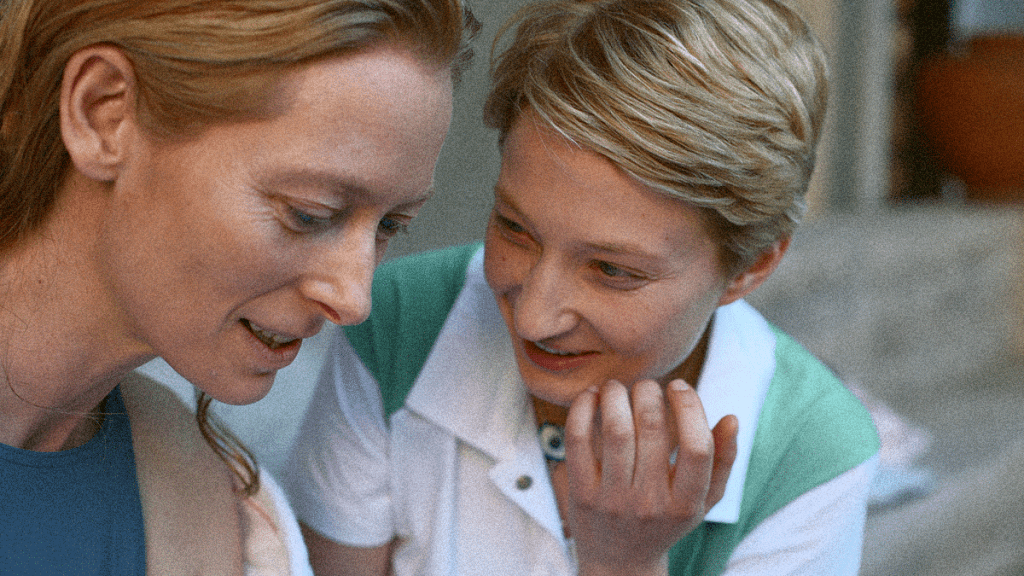
Tilda Swinton and Alba Rohrwacher in I AM LOVE, a Magnolia Pictures release. Photo courtesy of Magnolia Pictures.


 jaredmobarak.com
Leave a comment